 100% CANADIAN OWNED & OPERATED - FREE Shipping
- Use SUMMER for up to 60% off!
100% CANADIAN OWNED & OPERATED - FREE Shipping
- Use SUMMER for up to 60% off!

Elite Floor Stand

Kivo Elite Floor Stand: The Perfect Stand for your Elite Series Panel
Description
Description
Features
Features
Specifications
Specifications
Help & Support
Help & Support


LEDs
Certified for medical & clinical use
mW / cm²
Irradiance at source
Wavelengths
Powerful and Effective Light Therapy
1 year
Replacement Warranty
Backed by Lifetime Support
30°
Degree LEDs
Optimal skin penetration & dispersion
0µT
EMF Output
Ultra-high quality components
Kivo Elite Floor Stand

What's included with the Kivo Elite Floor Stand: The Perfect Stand for your Elite Series Panel
Kivo Elite Floor Stand Features

Kivo Elite Floor Stand Specifications

Kivo Elite Floor Stand Treatment Guide
- For best results use on clean dry bare skin
- MUST use provided goggles if using on the face
- Use a combination of red and near-infrared at the same time
- If you have a PRO panel, use BLUE light therapy before 1-2pm
- For Red and Near-Infrared Treatments use before 6pm
- 5 minutes on the face 10-15cm (3-6 inches) away
- 10 minutes on the body 10-15cm (3-6 inches) away
- Repeat daily, with one day off after every 5 days.
For improved sleep, use RED LIGHT ONLY pointed to the wall an hour before bedtime on 25-30% brightness setting.

Kivo Elite Floor Stand Certifications
The Elite Floor Stand is built to rigourous standards conforming to
- Health Canada Class 2 Medical Device
- FCC
- MDSAP Medical Device Single Audit Program (Australia, Canada, USA, Brazil, Japan)
- Australia: Therapeutic Goods Administration (TGA)
- Brazil: Brazilian Health Regulatory Agency (ANVISA)
- Canada: Health Canada
- Japan: Ministry of Health, Labour and Welfare (MHLW) and Pharmaceuticals and Medical Devices Agency (PMDA)
- United States: Food and Drug Administration (FDA)
- cETLus: issued by Intertek, a Nationally Recognized Testing Laboratory (NRTL). It signifies that a product has been independently tested and meets the exact same rigorous safety standards required for sale in both Canada and the United States
- Germany: TÜV Rheinland
- Japan: PSE certification and EMC approval for electrical and electronic products
- Europe: CE (Conformité Européenne) meets stringent EU safety, health, and environmental protection requirements
- SGS Certified
- RoHS
- ISO 9001
- global-mark
- ISO 13485
What can the Kivo Elite Floor Stand help with?
Kivo Light therapy is clinically proven, and with over 7,500 studies showing Light Therapy works. What is important is that the panels produce the specific wavelengths and sufficient power so you see the results you're looking for. In addition to quality components, help and advice, and useful features. The Elite Floor Stand is high-powered, with an irradiance (at source) of 190mw/cm2, incredibly reliable with a 1 year full-warranty, and has high-powered LEDs outputting clinically measured wavelengths. The Kivo Elite Floor Stand is a highly effective Light Therapy Panel used by people, professionals, clinics, and medical facilities to help resolve a wide range of physical and mental-health issues

The Kivo Elite Floor Stand can help with aches and pains
The deep penetration of near-infrared wavelengths that the Elite Floor Stand provides, can reach joints and tendons to help lower inflammation. This can help with pain relief for conditions like osteoarthritis or general joint wear and tear. It helps increase blood flow to the affected areas, bringing oxygen and nutrients needed for repair.

The Kivo Elite Floor Stand can help with skin health, anti-aging & skin rejuvenation
Red light therapy powered by the Elite Floor Stand stimulates fibroblasts to produce collagen and elastin. This helps reduce fine lines, wrinkles, and overall skin roughness. It also supports the healing of blemishes and sun damage by improving local blood flow.

The Kivo Elite Floor Stand can help with sleep
The Elite Floor Stand can help with sleep and your circadian rhythm. Using blue light from the Pro series, and red light only in the evenings from the Elite Floor Stand, light therapy can help simulate relaxing morning and sunsets, helping you get into the right rhythm for rejuvanating sleeps
Let's find the right size for you

300 SeriesView |

1000 SeriesView |

1500 SeriesView |

2400 SeriesView |

3600 SeriesView |
|
|---|---|---|---|---|---|
| Size | Small | 1/2 Body | 1/2 Body Wide | 3/4 Body Wide | Full Body |
| LEDS | 70 | 210 | 300 | 560 | 840 |
| Power Classification | 300w | 1000w | 1500w | 2400w | 3600w |
| Power Consumption | 80w | 380w | 585w | 790w | 995w |
| Size (mm) | 322 x 220 x 71 | 880 x 220 x 71 | 880 x 280 x 71 | 1159 x 419 x 71 | 1717 x 419 x 71 |
| Weight (KG) | 4.2 | 8.6 | 11.8 | 21.8 | 30 |
| EMF Emissions | 0.0 μT @ 6” | 0.0 μT @ 6” | 0.0 μT @ 6” | 0.0 μT @ 6” | 0.0 μT @ 6” |
| LED Lifespan | 100,000+ Hours | 100,000+ Hours | 100,000+ Hours | 100,000+ Hours | 100,000+ Hours |
| Warranty | 2-3-5 year | 2-3-5 year | 2-3-5 year | 2-3-5 year | 2-3-5 year |
Why choose Kivo?
Best in Construction
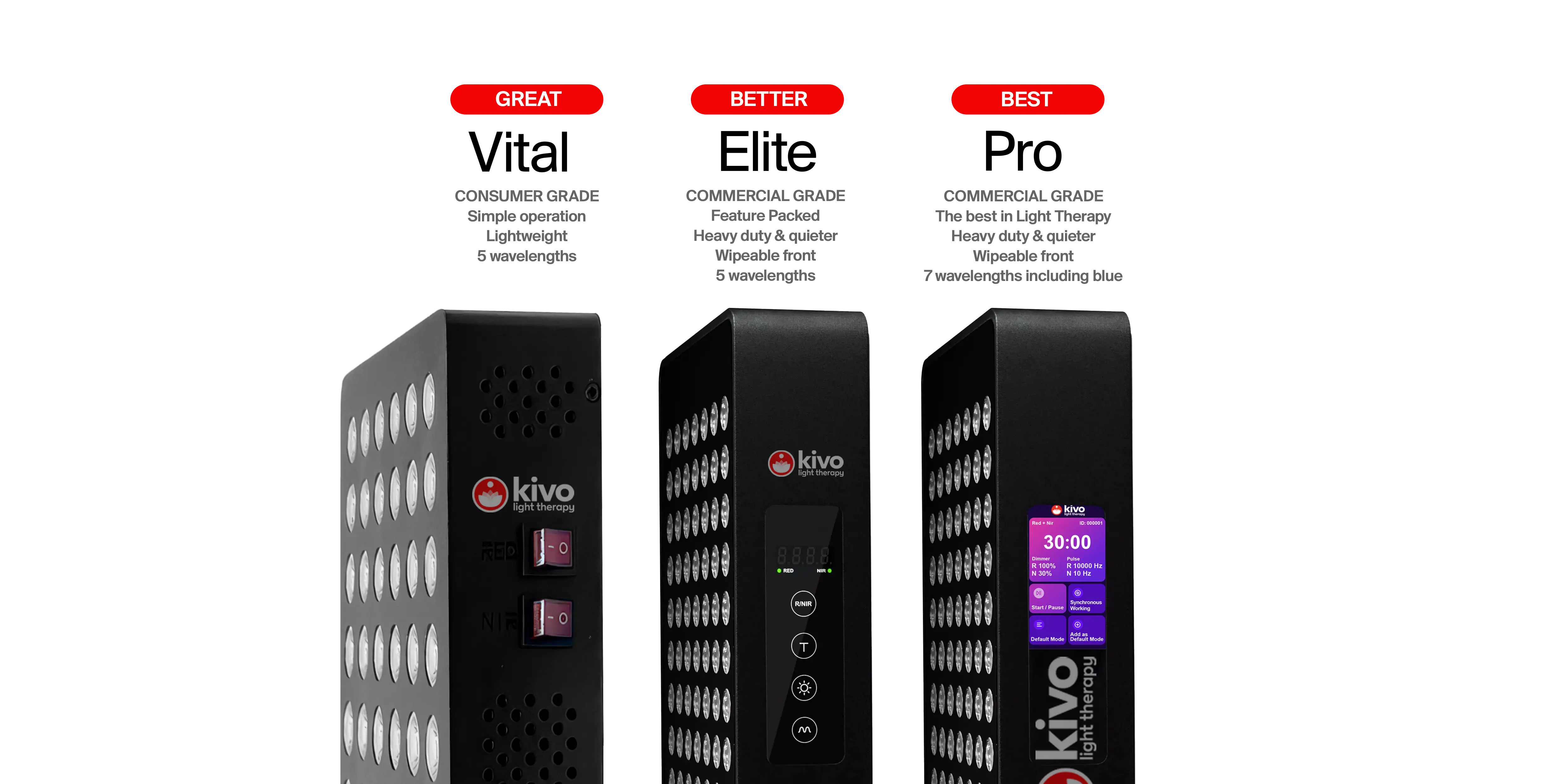
Other red light panels are built using thin steel. Kivo Elite and Pro 300 and above panels are constructed using aircraft grade aluminum that is 5 times thicker and stronger, and up to 2 times quieter as a result.
Best in Features
On our 300 and above series, Kivo provides a wipeable, protective clear acrylic front to our panels, protecting the lens and allowing you to sanitize and keep clean the front of your panel. Others don't bother with this, and cost-cut.
Best in Quality
Because the other manufacturers uses an open design, their fan's are loud. Kivo 300 and above Elite and Pro panel's use heavy weight heat-sinks, high-quality ball bearing fans, all to help Kivo panels be up to 2 times quieter than the competiton.
Best in Wavelengths
More is not necessary better, and less definitely isn't. Kivo uses clinically effective wavelengths to help your wellness journey.
Most other providers don't provide BLUE or extended NEAR-INFRARED or YELLOW wavelengths. Kivo does with our Pro Panels & Masks.

Frequently asked questions
What makes Kivo Therapy different?
What makes Kivo Therapy different?
Kivo has been producing custom built and quality built light therapy panels for years. We carry a wider range of panels, from small to large, from single to multiple, from consumer to professional clinical grade. All backed by comprehensive warranties, and lifetime support. We're here to help, and Light Therapy is our passion.
How long will it takes to see the results from using the Kivo Elite Floor Stand?
How long will it takes to see the results from using the Kivo Elite Floor Stand?
Light therapy is not a quick wonder drug. Similar to antibiotics where a careful and regular intake provides the most benefits - light therapy from the Kivo Elite Floor Stand is the same. Using the It performs best with a "little-and-often" approach of 10 minutes per area of the body per day. You will not see results immediately, but gradually over the space of a few weeks from using your Elite Floor Stand, you will see results. If you overdo light therapy, it's safe, but you will slow down the outcomes you're trying to achieve as it will exhaust your cells.
What is the Kivo Elite Floor Stand best for?
What is the Kivo Elite Floor Stand best for?
Kivo panels and the Elite Floor Stand are high quality, high irradiance light therapy panels that are clinically proven and backed by thousands of studies to help with a range of issues:
- Injury recovery - tendons, ligaments, and muscles especially
- Joint issues
- Skin issues
- Mental health
- Sleep
- Localized collagen production to help with anti-aging and wrinkles
- Improves cellular processes
What is the warranty or returns period for the Kivo Elite Floor Stand
What is the warranty or returns period for the Kivo Elite Floor Stand
The Elite Floor Stand and all Kivo devices are highly reliable, with our Vitals being fully covered under a 2 year warranty, our Elites with a 3 year, and our Pros having an industry leading 5 year warranty - for residential use. The Elite Floor Stand comes with a comprehensive 1 year warranty - and lifetime support.
If you'd like to return your panel, it's ok. Maybe you don't have the time, or the commitment to participate in light therapy. We accept returns generally for up to 60 days for most of our products as long as they're in as new condition. See our returns policy for more information.
How do I get help with my Elite Floor Stand?
How do I get help with my Elite Floor Stand?
Light Therapy can be daunting, we've compiled help articles, treatment guides, manuals, and the best ways to get the most out of your Elite Floor Stand.
See https://help.KivoTherapy.com for in-depth help, support, PDF manuals, guides, and more..
The All Natural Healing Power of Light
The Elite Floor Stand can help increase Collagen
Collagen is a protein that provides structure and support to the body's connective tissues, including skin, bones, tendons, and ligaments. It is essential, and Red Light Therapy helps your cells create it, in the right places, in your body. Naturally.
The Elite Floor Stand can help with Anxiety & Depression
Red and Near Infra-Red Light placed near your head has proven, in a Harvard Study, to reduce Anxiety by up to 75% for an entire month - with just 1 treatment. Imagine.. what a daily treatment with your own Kivo device could do for you.
The Elite Floor Stand can help with Muscle Recovery
Red Light Therapy is proven to accelerate muscle rehabilitation times. Our panels are used by RMT, Osteopaths, Chiropractors, and Health Experts to aid in clinical practice.
The Elite Floor Stand can help with Better Sleep
Red Light at Night and in the Morning can help aid a better nights sleep, blocking blue light, and helping with your Circadian Rhythm.

Real People Real Results
★★★★★ Light Therapy is Life Changing


Learn about Light Therapy

How Long Should I Do Light Therapy For?
How Long Should I Do Light Therapy For? If you recently got a light therapy panel, mask, or flashlight - or if you are looking into getting one for skin care or muscle recovery - you probably have one big question on your mind: How long should each session actually last? It is easy to think that sitting in front of a light for an hour will give you four times the benefits of a 15-minute session. Light therapy does not work that way. Your cells have a sweet spot for how much light energy they can take in at one time. Here is a straightforward guide to help you set the right timers for your sessions based on the exact wavelengths used in Kivo Light Therapy devices. The Core Rule: Why More Light Is Not Always Better Light therapy works through a scientific rule called the biphasic dose response. That sounds technical, but the idea is simple: Too little light: Your cells do not get enough energy to trigger changes. The right amount of light: Your cells get energized, speeding up repair and collagen production. Too much light: Your cells get full, lose their boost, and temporarily stop responding. Think of it like charging a smartphone. Once your battery hits 100%, leaving it on the charger for another five hours will not give you extra battery life. Keeping your sessions within the recommended time window gives you the best results without wasting time. Session Times by Light Wavelength & Goal Different light wavelengths reach different depths in your tissue. Here is how long you should run each specific light mode. 1. Blue Light Therapy (480nm Wavelength) What it targets: Skin surface, acne-causing bacteria, and oil balance. Ideal session length: 3 to 5 minutes per area (up to 10 minutes maximum for a full face treatment). Distance from skin: 3 to 6 inches (10 to 15 cm). Best time of day: Morning or early afternoon (before 1-2 pm). Blue light is fantastic for clearing up surface spots and keeping skin clean. Because blue light mimics bright daylight, it tells your brain that it is time to wake up. Using blue light late in the evening can mess with your body clock and make it harder to fall asleep at night. If you are using a portable option like the Kivo Pro Flashlight on small spots, 5 minutes per spot is plenty. If you are using a multi-light panel like the Kivo ONE Pro Panel, set the timer for 10 minutes on your face. 2. Red Light Therapy (630nm and 660nm Wavelengths) What it targets: Skin health, collagen production, reducing redness, and soothing surface inflammation. Ideal session length: Face treatments: 10 minutes. Body areas (shoulders, arms, back): 10 to 15 minutes. Distance from skin: 3 to 6 inches (10 to 15 cm). Best time of day: Any time before 6 pm. Red light reaches the outer layers of your skin to help rebuild collagen and keep your skin tone balanced. A quick 10-minute session on your face with a device like the Kivo Elite Face Mask or a panel from the Kivo ONE Series is enough to give your skin cells a solid energy bump. 3. Near-Infrared Light Therapy (810nm, 830nm, 850nm, and 940nm Wavelengths) What it targets: Deeper muscle tissue, joints, tendons, and post-workout recovery. Ideal session length: 10 to 15 minutes per target area. Distance from skin: 3 to 6 inches (10 to 15 cm). Best time of day: Before 6 pm. Near-infrared (NIR) light is invisible to the human eye, but it travels deeper into your body than red or blue light. It reaches sored muscles and stiff joints to lower soreness after workouts or sports. Because NIR light goes deeper, your tissue benefits from a slightly longer session of 10 to 15 minutes per zone. Larger setups like the Kivo THREE Series or the full-body Kivo TWELVE Series allow you to cover larger areas of your body in one single 10 to 15 minute run. 4. Scalp Care (660nm Red and 850nm Near-Infrared) What it targets: Scalp circulation and hair follicle health. Ideal session length: 10 minutes per session. Frequency: 3 to 4 times per week. For hair and scalp health, consistency matters more than long individual sessions. A dedicated device like the Kivo LED Light Therapy Cap uses dual-chip LEDs to deliver red and near-infrared light right to the hair roots in an easy 10-minute automated routine. Step-by-Step Instructions for Your Light Routine To get clean, predictable results every time, follow these steps during your regular sessions: Step 1: Clean your skin. Wash off makeup, sunscreen, or heavy lotions before starting. Clean, bare skin lets the light penetrate without reflections. Step 2: Put on eye protection. Put on dark protective goggles (like the eye guards included with Kivo panels) when treating your face or working near your eyes. Step 3: Check your distance. Position yourself 3 to 6 inches (10 to 15 cm) away from the panel or device. Step 4: Select your light mode. Use Blue Light in the morning for acne or surface skin care. Use Red + Near-Infrared Light for general skin glow, joint relief, or muscle recovery. Step 5: Set your timer. Keep face treatments between 3 and 5 minutes. Keep muscle or joint treatments between 10 and 15 minutes. Step 6: Finish with your standard skin routine. Apply your usual moisturizer or serum after your session is finished. Quick Reference Cheatsheet Light Color / Type Target Wavelengths Recommended Time Target Area Best Time of Day Blue Light 480nm 3 - 5 minutes Facial skin, spots, breakouts Morning to 2:00 PM Red Light 630nm, 660nm 5 - 10 minutes Face, chest, skin tone Morning or afternoon (before 6:00 PM) Near-Infrared (NIR) 810nm, 830nm, 850nm, 940nm 10 - 15 minutes Muscles, joints, deep repair Before 6:00 PM Scalp Care 660nm + 850nm 10 minutes Scalp and hair roots Any time during the day Common Mistakes to Watch Out For Sitting too close or too far: Sitting 2 feet away makes the light too weak to be effective. Pressing up against a high-power panel can make the area uncomfortably warm. Stick to the 3-to-6 inch range. Using blue light at night: Blue light tricks your brain into thinking it is noon. Stick to morning use for blue light so your evening sleep signals stay normal. Overdoing it out of impatience: Doing three 20-minute sessions in one day will not speed up your skin progress. Stick to 3 to 5 regular sessions per week. Skipping eye protection: Light panels are very bright. Always use protective goggles during facial treatments. Simple Summary for Getting Started Keep face treatments between 5 and 10 minutes. Keep body and muscle treatments between 15 and 20 minutes. Stay 3 to 6 inches away from your panel during treatment. Repeat your routine 3 to 5 days a week. Focus on consistency over duration... short regular sessions beat long random ones every time!
Learn more
BEWARE of cheap Red Light
Red light therapy has grown rapidly in popularity, and for good reason. It supports cellular health, speeds up muscle recovery, and keeps skin looking fresh. But as demand builds, a serious problem has appeared online. The market is flooded with dirt-cheap panels that look fine on the outside but are completely hollow, ineffective, or even harmful on the inside.
Learn more
Red Light Therapy for Pets
If you have ever looked for ways to help your aging pet move more comfortably or speed up the healing of a small scrape, you might have heard about red light therapy. Often called photobiomodulation, this approach is becoming quite common in veterinary care. It is a non-invasive, drug-free way to help our furry, and non-furry family friends feel better.
Learn more
Red Light Therapy for Migraines and Headaches
Migraine sufferers often search for non-invasive solutions that avoid the side effects associated with traditional pharmaceutical treatments. Red and Near-Infrared light are gaining recognition as evidence-based tools for long-term migraine prevention and management.
Learn more
Red Light Therapy Dosage Calculator
Getting the right dosage of Light Therapy is crucial to obtaining the results you're looking for. Our exclusive algorithm takes into account the outcomes of thousands of customers, feedback, as well as the results of numerous scientific studies, we've built a red light therapy dosage calculator that takes in the irradiance of a device, the distance you want to use it, whether you're changing brightness / pulse modes / treatment type, and takes all of that into account to calculate the correct dosage you need. Red Light Dosage Calculator
Learn more
Red Light & Near-Infrared Therapy for Concussions & Head Injury Recovery
Red and near-infrared light therapy—also known as photobiomodulation—is emerging as a promising treatment for concussions and brain injuries. By boosting cellular energy, improving blood flow, and reducing inflammation, red light helps the brain recover naturally after trauma. Clinical studies from institutions like Mass General Hospital and JAMA Network show it can improve brain connectivity, memory, and mood following head injuries.
Learn more
How Red Light & Near-Infrared Therapy Can Optimize Pre-Op and Post-Op Surgical Recovery
Red and near-infrared light therapy (often called photobiomodulation) can be a powerful ally before and after surgery. By boosting cellular energy, improving circulation, and reducing inflammation, this safe, non-invasive treatment helps your body recover faster, with less pain and smoother healing. When used pre-surgery, it “preconditions” tissues for better resilience, and post-surgery it supports faster wound repair and scar reduction.
Learn more
Red and Near-Infrared to help Nerve Regeneration
Nerve damage is one of the most challenging conditions to treat. Whether caused by injury, surgery, diabetes, or chronic illnesses, damage to peripheral nerves often leads to pain, numbness, tingling, and impaired function. Unlike skin or muscle, nerve tissue regenerates very slowly, and in some cases, healing is incomplete. Traditional treatments often focus on managing symptoms rather than repairing the underlying damage. In recent years, however, there has been growing interest in a non-invasive approach that may support the body’s ability to repair nerve tissue: red and near-infrared (NIR) light therapy, also known as photobiomodulation (PBM). Studies are beginning to show that PBM can stimulate cellular repair processes, improve circulation, and enhance recovery in nerve-related conditions. So, how does this work — and what does the science say? How Red and Near-Infrared Light Affect Nerve Cells Both red light (around 630–660 nm) and near-infrared light (around 810–850 nm) penetrate tissues and are absorbed by mitochondria, the “powerhouses” of cells. Specifically, they target an enzyme called cytochrome c oxidase, which is part of the mitochondrial respiratory chain. When stimulated by these wavelengths, mitochondria produce more ATP (adenosine triphosphate) — the energy currency of the cell (NIH). In nerve cells, this extra energy allows for: Axonal repair: Damaged axons (the long projections of neurons) can regrow when energy demands are met. Myelin regeneration: Light therapy may support the repair of myelin, the protective sheath around nerves that is critical for fast and accurate signal transmission. Protein synthesis: Increased ATP fuels the creation of structural proteins needed for nerve repair. In short, light therapy helps “recharge” injured nerves so they can carry out the demanding process of repair. Reducing Oxidative Stress and Inflammation Nerve injury often creates an environment of oxidative stress, where excessive reactive oxygen species (ROS) damage cellular components. Photobiomodulation helps normalize ROS levels by making mitochondria more efficient. This not only protects neurons but also reduces secondary damage that can occur after the initial injury. In addition, light therapy reduces inflammatory cytokines — signalling proteins that can prolong pain and impair healing. By calming the inflammatory response, PBM creates a more favorable environment for regeneration. Research in the Journal of Neurotrauma found that NIR therapy not only reduced oxidative stress but also improved functional recovery after nerve injury (PubMed). Stimulating Neurotrophic Factors One of the most promising findings is that red and NIR light increase levels of neurotrophic factors. These are proteins that guide nerve growth, survival, and function. Among the most important are: Nerve Growth Factor (NGF): Promotes survival and growth of sensory and sympathetic neurons. Brain-Derived Neurotrophic Factor (BDNF): Supports synaptic plasticity, learning, and repair. A study published in Neuroscience Letters found that PBM increased expression of BDNF and NGF in animal models, leading to enhanced axon regeneration and functional recovery (NIH). This means that light therapy doesn’t just provide energy; it also helps activate the genetic and molecular programs necessary for nerves to rebuild themselves. Improving Circulation and Nutrient Delivery Nerves, especially peripheral nerves, have limited blood supply compared to other tissues. Poor circulation can slow healing and leave damaged nerves starved of oxygen and nutrients. Near-infrared light penetrates deeper than red light and stimulates nitric oxide release, which relaxes blood vessels and improves microcirculation. A study in Lasers in Surgery and Medicine demonstrated that animals treated with NIR after nerve injury had faster functional recovery and improved nerve conduction velocity compared to controls (PubMed). Improved blood flow is key not only for repair but also for clearing out metabolic waste products that accumulate in injured tissues. Evidence from Clinical and Preclinical Studies While much of the research has been done in animal models, the results are encouraging - and early human studies are beginning to confirm the benefits. Peripheral nerve injury: Animal studies show that PBM accelerates axonal regrowth and improves recovery of motor and sensory function. Carpal tunnel syndrome: Clinical trials using NIR light have reported reductions in pain and improvements in grip strength and nerve conduction (PubMed). Diabetic neuropathy: Studies suggest that PBM reduces pain and numbness while improving quality of life for patients with diabetic nerve damage. Post-surgical nerve recovery: Patients treated with red/NIR light after surgery have shown reduced pain, less inflammation, and better long-term functional outcomes. Although more large-scale clinical trials are needed, the existing data strongly suggest that photobiomodulation is a safe and effective adjunct therapy for nerve regeneration. What Patients Report Beyond the lab, many people using red and near-infrared therapy devices report improvements such as: Reduced tingling and numbness Decreased nerve pain Improved muscle activation in affected areas Better coordination and grip strength While individual results vary, these reports align with the physiological mechanisms demonstrated in research. Suggested Protocol for Nerve Regeneration (Using the Kivo Elite Panel) If you are considering red and NIR light therapy at home, consistency is key. Nerve healing is slow, and results are usually seen over weeks to months. A commonly recommended protocol is: Wavelength: Red + Near-Infrared Brightness: High (Level 5 on Kivo Elite Panel) Pulse: 40 Hz (associated with neurological repair and brain wave entrainment) Duration: 15–20 minutes per affected area Frequency: 5–7 times per week Treatment Length: At least 8–12 weeks, longer for chronic conditions This can be used alongside conventional treatments such as physical therapy, medications, and lifestyle interventions. Always consult a healthcare provider before starting new therapies, especially if you have a medical condition. For more Light Therapy Treatment Protocols, visit our help site: https://help.KivoTherapy.com Why This Matters Nerve damage can be life-changing, affecting mobility, sensation, and independence. Traditional medicine often offers limited solutions beyond pain relief. Light therapy represents a shift — instead of masking symptoms, it seeks to help the body heal itself. As the research base expands, red and near-infrared therapy may become a standard part of nerve rehabilitation protocols, both in clinics and at home. Devices like the Kivo Elite Panel make it possible to access this promising therapy safely and consistently. For those dealing with nerve injuries, neuropathy, or post-surgical recovery, photobiomodulation offers real hope: faster healing, less pain, and a better chance of regaining function.
Learn more



