100% CANADIAN OWNED & OPERATED - FAST FREE Shipping
- Get a
100% CANADIAN OWNED & OPERATED - FAST FREE Shipping
- Get a 
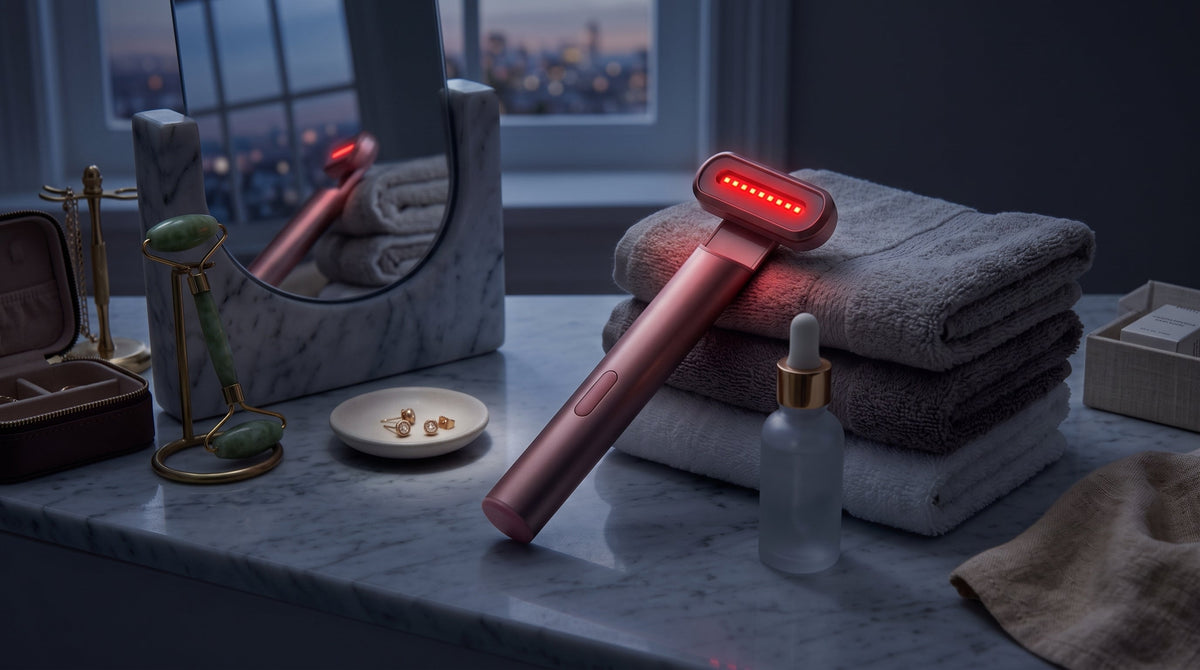
Why Red Light Therapy Wands Are a Waste of Money (A Clinical Reality Check)
Small handheld red light wands are advertised everywhere across social media. Companies claim that waving a tiny, battery-operated stick over your skin for three minutes will lift wrinkles, clear acne, and firm your face.
As clinicians and photomedicine practitioners, we see patients invest their hard-earned money into these pocket tools and wonder why they see zero clinical change.
The honest answer is grounded in biophysics: handheld red light wands do not possess the power density, coverage area, or energy output required to trigger cellular repair.
Here is the exact medical science, the clinical math, and the physical reasons why red light wands fail to deliver results.
1. The Clinical Math: The Law of Photomedicine Dosimetry
In photobiology, light is not magic - it is a measurable medical dose. To stimulate fibroblasts and produce new collagen, target cells must absorb a specific quantity of photons.
Photobiomodulation dosing depends on a strict physical formula:
-
Dose (Joules/cm²) = Irradiance (Watts/cm²) × Time (Seconds)
-
Irradiance measures the number of photons hitting a square centimeter of skin per second.
-
Joules measure the total energy delivered to the tissue.
Clinical trials establish clear minimum thresholds:
- Research published in Dose-Response by Huang et al. (2009) demonstrates that effective photobiomodulation requires a therapeutic target dose between 4 J/cm² and 10 J/cm² directly at the target tissue layer.
- Work by Avci et al. (2013) on Low-Level Light Therapy confirms that sub-threshold energy yields zero physiological stimulation.
How Wands Fail the Math:
-
Tiny irradiance output: Most consumer wands deliver between 2 mW/cm² and 5 mW/cm² (0.002 to 0.005 W/cm²) when pressed flat against skin.
-
Time required for one spot: At 5 mW/cm², delivering a standard 5 J/cm² clinical dose requires:
- 5 J/cm² ÷ 0.005 W/cm² = 1,000 seconds (16 minutes and 40 seconds) on that single spot.
-
Surface area of the wand tip: A wand head is typically only 1.2 cm to 1.5 cm².
-
Surface area of the human face: An average adult face measures roughly 350 to 400 cm².
-
The real time needed: To treat an entire face with a wand at therapeutic levels, you would need to hold it stationary over roughly 230 individual spots:
- 230 spots × 16.6 minutes = 3,818 minutes (over 63 hours of continuous treatment).
2. The "Gliding" Trap and the Arndt-Schulz Law
Wand manufacturers tell users to "glide" the device smoothly across their face for 3 to 5 minutes total. This instruction completely destroys any therapeutic value.
-
Dilution across the face: Sweeping a 1.5 cm² wand head over a 350 cm² face for 5 minutes (300 seconds) means any individual patch of skin receives only about 1.3 seconds of direct light.
-
The resulting dose:
- 0.005 W/cm² × 1.3 seconds = 0.0065 J/cm² (6.5 milliJoules).
-
The clinical deficit: 0.0065 J/cm² is less than 0.2% of the minimum 4 J/cm² dose required to stimulate collagen synthesis.
This brings in a fundamental biological principle: the Arndt-Schulz Law.
- The Arndt-Schulz curve proves that biological systems require a minimum threshold of optical energy to trigger an enzymatic response.
- Doses below the threshold produce zero cellular effect - not a small effect, but none.
- Cells do not "save up" or store disconnected fractions of energy delivered in passing sweeps.
- As detailed in peer-reviewed photobiology reviews by Hamblin (2008), without sufficient energy density, cytochrome c oxidase inside the mitochondria remains completely inactive.
3. Optical Physics: Tissue Scattering and Penetration Depth
Skin is an effective optical barrier designed to scatter and absorb incoming light before it damages internal structures.
-
Epidermal barrier: The stratum corneum, melanin pigments, and intracellular water scatter photons immediately upon contact.
-
Target depth: To stimulate collagen, elastin, and extracellular matrix remodeling, light must reach the reticular dermis, which sits 1 to 2 millimeters below the surface.
-
Photon density matters: Photons scatter in a conical pattern. Low-intensity light from a 5 mW/cm² diode loses almost all its energy in the uppermost dead cellular layers.
-
Zero penetration: Without high initial photon density, near-infrared (810nm - 850nm) and deep red (630nm - 660nm) cannot reach the fibroblasts in numbers sufficient to stimulate repair.
- Review studies in Seminars in Cutaneous Medicine and Surgery by Barolet (2008) show that clinical skin outcomes require high photon flux to ensure enough light survives past the dermal-epidermal junction.
4. Hardware Limitations: Batteries, Heat, and Diode Drift
A clinical phototherapy device requires serious electrical components. Wands are limited by basic engineering constraints:
-
Tiny batteries: Most wands run on small 300 mAh to 500 mAh rechargeable batteries. A high-output LED array draws substantial wattage. Running therapeutic LEDs would drain a wand battery in under two minutes.
-
Lack of thermal management: High-output LEDs generate heat behind the diode. Professional panels use heavy extruded aluminum heatsinks and cooling fans to prevent overheating.
-
Thermal throttling: A small plastic or aluminum stick cannot dissipate heat. Manufacturers are forced to run their LEDs at a fraction of their rated power to prevent the casing from burning your hand.
-
Wavelength drift: Cheap diodes running hot experience wavelength shifts. Instead of emitting precise peaks at 630nm or 660nm, their output drifts into non-therapeutic light bands that have little affinity for mitochondrial enzymes.
5. The Deception: Why People Think Wands Work
If red light wands do not emit enough light to work, why do some customers claim their skin looks better right after use?
The answer lies in secondary features added to mask the weak LEDs:
-
Resistive warmth: Wands include small heating elements. Mild heat temporarily dilates surface capillaries, creating a temporary flush that mimics a "glow."
-
Sonic vibration: Vibration stimulates lymphatic drainage and causes slight temporary edema (mild fluid retention in surface tissue).
-
The illusion of fullness: This mild swelling temporarily smooths fine lines for 20 to 30 minutes following treatment.
-
Microcurrent tingling: Low-voltage electric current causes minor muscle contraction.
- None of these temporary effects come from the red light itself. Once the heat and vibration wear off, the underlying collagen architecture remains completely unchanged.
Wands vs. Clinical-Grade Panels: A Direct Comparison
To see why clinical practitioners recommend stationary light arrays, review how the specifications compare:
|
Parameter |
Cosmetic Red Light Wand |
Clinical Panel (e.g., Kivo Panels) |
|
Real Irradiance |
2 - 5 mW/cm² at surface |
60 - 100+ mW/cm² at 6 inches |
|
Active Surface Area |
1 - 2 cm² |
300 - 1,500+ cm² |
|
Dwell Time per Spot |
Under 2 seconds (moving) |
10 minutes continuous |
|
Delivered Dose |
Less than 0.01 J/cm² |
5 - 15 J/cm² (proven clinical window) |
|
Wavelength Stability |
High thermal drift |
Active heatsink / stable peak output |
|
Coverage |
Fractional / inconsistent |
Full face and neck simultaneously |
|
Clinical Effect |
Negligible |
Documented fibroblast stimulation |
Step-by-Step Guide: How to Evaluate Real Phototherapy Equipment
Before spending money on any red light device, follow this step-by-step checklist to ensure you receive a working clinical tool:
-
Check the Irradiance at Treatment Distance
- Do not buy devices that only quote irradiance at "0 inches" or against the glass.
- Demand verified irradiance data taken with a calibrated spectroradiometer at a practical distance (6 to 12 inches).
- Look for at least 40 to 80 mW/cm² at your intended standing or sitting distance.
-
Calculate Total Surface Area Coverage
- Ensure the light covers your entire target area (such as the full face and neck) simultaneously.
- Stationary exposure allows every cell to absorb photons for the full 10-minute duration without dilution.
-
Verify Wavelength Accuracy
- Look for verified peak wavelengths backed by clinical literature: 630nm / 660nm for red light, and 830nm / 850nm for near-infrared light.
- Avoid devices that do not specify exact nanometer ratings.
-
Confirm Solid Thermal Architecture
- Real high-power LEDs require aluminum heat sinks and internal cooling fans.
- If a device has no cooling vents, no aluminum body mass, and runs silently on a tiny cell phone battery, its optical output is too low for therapeutic use.
-
Review Clinical Trials on Fixed-Position Therapy
- Studies demonstrating wrinkle reduction and dermal density increases - such as the trial by Wunsch & Matuschka (2014) - use stationary arrays that bathe tissue in continuous, high-density light.
The Verdict
Small red light wands are cosmetic novelties. While they are easy to pack in a travel bag, they fail the most basic laws of photobiology.
If your goal is genuine collagen remodeling, skin firming, and cellular repair, your cells require adequate optical power and continuous exposure. Invest in full-surface, high-irradiance equipment - such as our Kivo light therapy panels or our clinical guides to irradiance - where the physical dosage meets the requirements of real medicine.
Clinical References
-
Huang, Y. Y., Chen, A. C. H., Carroll, J. D., & Hamblin, M. R. (2009). Biphasic dose response in low level light therapy. Dose-Response, 7(4), 358-383. PubMed Link
-
Barolet, D. (2008). Light-emitting diodes (LEDs) in dermatology. Seminars in Cutaneous Medicine and Surgery, 27(4), 227-238. PubMed Link
-
Avci, P., Gupta, A., Sadasivam, M., Vecchio, D., Pam, Z., Pam, N., & Hamblin, M. R. (2013). Low-level laser (light) therapy (LLLT) in skin: stimulating, healing, restoring. Seminars in Cutaneous Medicine and Surgery, 32(1), 41-52. PubMed Link
- Wunsch, A., & Matuschka, K. (2014). A controlled trial to determine the efficacy of red and near-infrared light treatment in patient satisfaction, reduction of fine lines, wrinkles, skin roughness, and intradermal collagen density increase. Photomedicine and Laser Surgery, 32(2), 93-100. PubMed Link